

For years, Sindi Dlathu has been one of the most recognisable faces on South African television, but with that familiarity has come an increasingly common question from viewers: has the veteran actress been typecast as the powerful, intimidating woman?
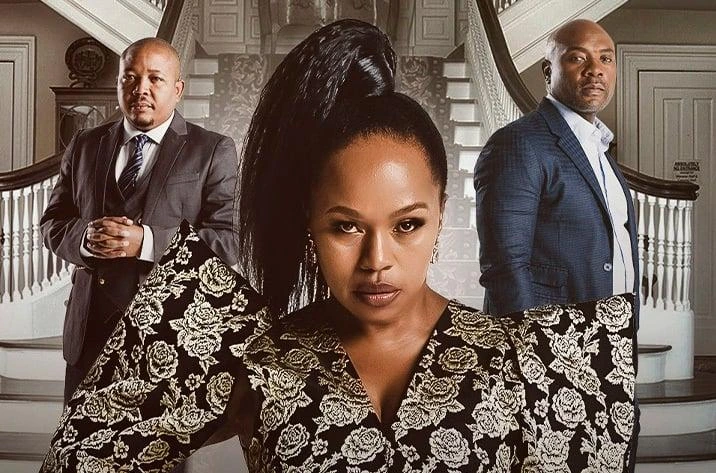
The conversation has resurfaced following the Netflix debut of Umthetho, where Dlathu plays Agnes Khoza, the ruthless Head of Centre at the prison at the heart of the South African crime thriller, a role that once again places her in a position of authority and power.
Rather than treating the criticism as something she can simply control, Dlathu’s response has been notably matter-of-fact, telling News24, “Nothing I can do,” when asked about the typecasting conversation surrounding her latest role.
It is a response that perhaps says as much about the realities of the South African television industry as it does about Dlathu herself, because while audiences may recognise similarities between some of her characters, the actress has consistently approached each role as a new piece of work rather than allowing public perception to dictate her career.
From Thandaza to Lindiwe and now Agnes
The typecasting debate is understandable when looking at some of the characters that have defined Sindi Dlathu’s career, particularly Thandaza in Muvhango and Lindiwe Dikana in The River, two roles that cemented her reputation as one of Mzansi’s most commanding television performers.
Dlathu spent two decades playing Thandaza on Muvhango, a character so closely associated with her that viewers continued to recognise her through the role even after she left the soapie, while her move to The River gave audiences Lindiwe, a wealthy and calculating woman whose darker side became one of the show’s biggest attractions.
Lindiwe, in particular, demonstrated why the conversation around Sindi Dlathu typecasting refuses to disappear, as the character was a ruthless businesswoman and villain whose ambition, manipulation and emotional complexity gave Dlathu plenty of material to work with, with the actress previously describing Lindiwe as so different from herself that she barely recognised herself while watching the character on screen.
Now, with Umthetho, viewers are meeting Agnes Khoza, another formidable woman who operates from a position of authority, reinforcing the perception that Sindi Dlathu has become synonymous with powerful women in South African television.
Yet reducing her work to that description misses an important part of the actress’s career, because her performances have never relied solely on the status of the characters she plays, but rather on the emotional detail she brings to them.
Sindi Dlathu has never hidden her desire to grow
The typecasting debate is also not new, and Dlathu herself has previously spoken about wanting to expand beyond the character that made her a household name.
When she left Muvhango after 20 years, the actress said she wanted to give Thandaza a break so she could grow as an artist, explore new opportunities and discover what she could do as both an actress and a person.
That decision eventually led her to The River, where she was given one of her most dramatically demanding roles in Lindiwe Dikana, and the performance proved that audiences were willing to follow Dlathu beyond Thandaza.
The actress has also previously acknowledged the complicated relationship performers can have with their characters, explaining that actors can immerse themselves so deeply in a role that separating their own emotions from those of the character is not always straightforward.
That ability to disappear into a character may, ironically, be part of why audiences continue to see similarities between her roles, because a convincing performance can become so closely associated with an actor that viewers begin to expect the same qualities in whatever comes next.
Agnes Khoza gives the conversation another layer
In Umthetho, Sindi Dlathu plays Agnes Khoza within a story centred on justice, family, prison power and survival, with the series following a young prosecutor who becomes entangled in a brutal prison syndicate led by the brother she believed she had lost.
The series, which premiered globally on Netflix on 14 August 2026, is a South African adaptation of the Brazilian series Brotherhood, and Dlathu is part of an ensemble that includes Nqobile Nunu Khumalo, Tony Kgoroge, Molefi Monaisa, Lorcia Cooper-Khumalo and Sthembiso “SK” Khoza.
Agnes may once again be a powerful woman, but that does not necessarily mean she is a repeat of Lindiwe or Thandaza, and that distinction is important when discussing whether Sindi Dlathu is genuinely typecast or simply exceptionally good at portraying characters who command attention.
For an actress with more than three decades in the industry, being repeatedly trusted with substantial roles can also be viewed from another angle: producers know she can carry complicated characters, while audiences know that when Sindi Dlathu appears on screen, the performance is unlikely to be forgettable.
The public’s opinion versus an actor’s responsibility
The conversation around Sindi Dlathu’s typecasting also raises a bigger question about how South African audiences view established actors, particularly performers who have spent decades building recognisable screen identities.
Viewers understandably want to see their favourite actors stretch themselves, and there is nothing wrong with asking for greater variety, especially in an industry where actors can sometimes become trapped in familiar character archetypes, but an actor’s responsibility ultimately remains with the performance rather than with satisfying every expectation placed on them by social media.
Dlathu appears to understand that distinction, and her response to the typecasting discussion suggests that she is not particularly interested in allowing public perception to become the measure of her career.
That approach is consistent with what she has said about her work over the years, including her more recent reflection that she wants to be known for her work and finds fulfilment in continuing to perfect her craft rather than becoming overly concerned with how others perceive her.
For Sindi Dlathu, then, the typecasting debate may continue every time she walks onto a set as another formidable woman, but Umthetho gives her another opportunity to make the character her own, and ultimately that may be the strongest answer an actor can give.